Valentin Tsatskin
About me
I am interested in Climate Change, Software Engineering, Software Correctness & Verification, Machine Learning, Data Analysis and Visualization, Web Development, Design, and Typography.
I’m a graduate of the Systems Design Engineering program at the University of Waterloo.
You may contact me at [email protected].
Table of Contents
Resume
My resume is exclusively available as a PDF:
(Even though it’s print media ain’t dead yet).
Reports & Papers
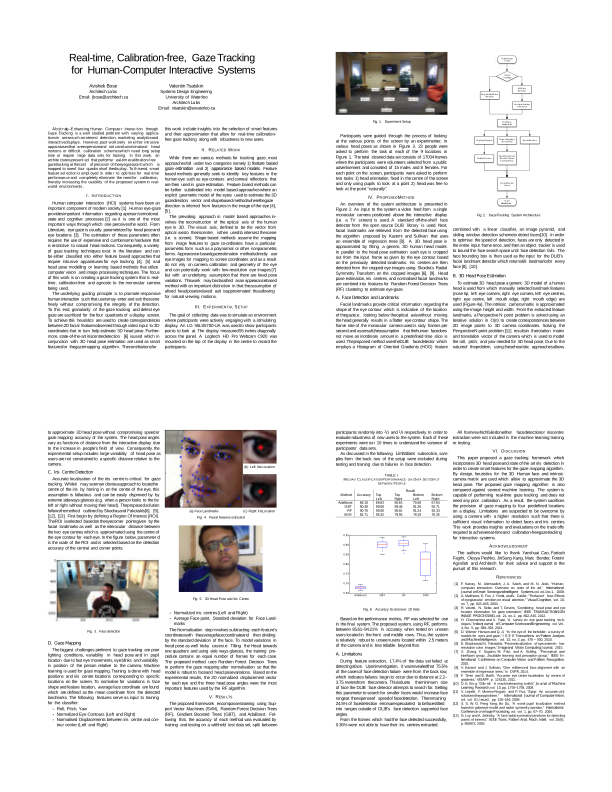
Real-time, Calibration-free, Gaze Tracking for Human-Computer Interactive Systems (2015)
Abstract—Enhancing Human Computer Interaction through Gaze Tracking is a well studied problem with varying applications in areas such as interest detection, marketing analytics and interactive displays. However, past works rely on either intrusive apparatuses that are expensive and not conducive to natural head motions or difficult calibration schemes which need long setup time or require large data sets for training. In this work, an architecture is presented that performs real-time calibration-free gaze tracking at the cost of precision of the eye gaze point which is mapped to one of four quadrants of the display. To this end, smart feature selection is employed in order to optimize for real-time performance and completely eliminate the need for calibration, thereby increasing the usability of the proposed system in real-world environments.
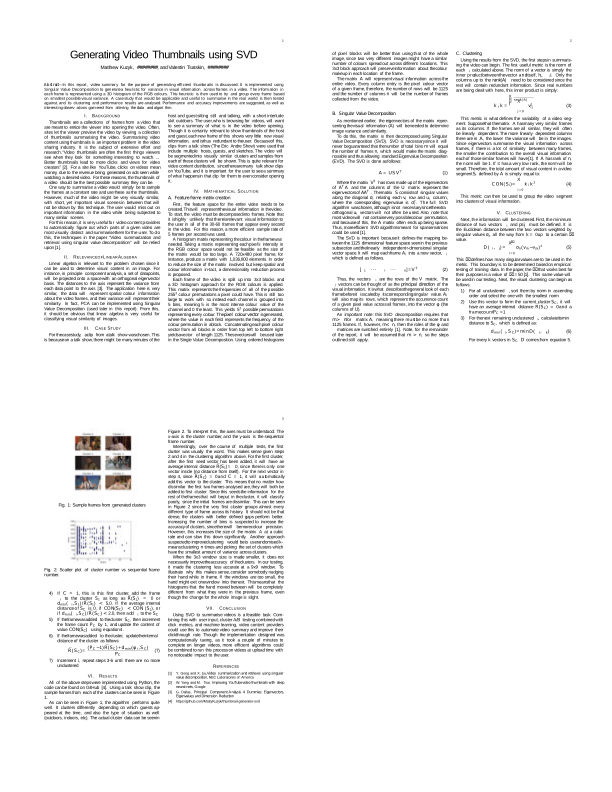
Generating Video Thumbnails using Singular Value Decomposition (SVD) (2016)
Abstract—In this report, video summary for the purpose of generating efficient thumbnails is discussed. It is implemented using Singular Value Decomposition to generate a heuristic for variance in visual information across frames in a video. The information in each frame is represented using a 3D histogram of the RGB colours. This heuristic is then used to try and group every frame based on smallest possible visual variance. A case study that would be applicable and useful to summarise in the real world is then tested against, and its clustering and performance results are analysed. Performance and accuracy improvements are suggested, as well as interesting observations garnered from altering the data and algorithm.
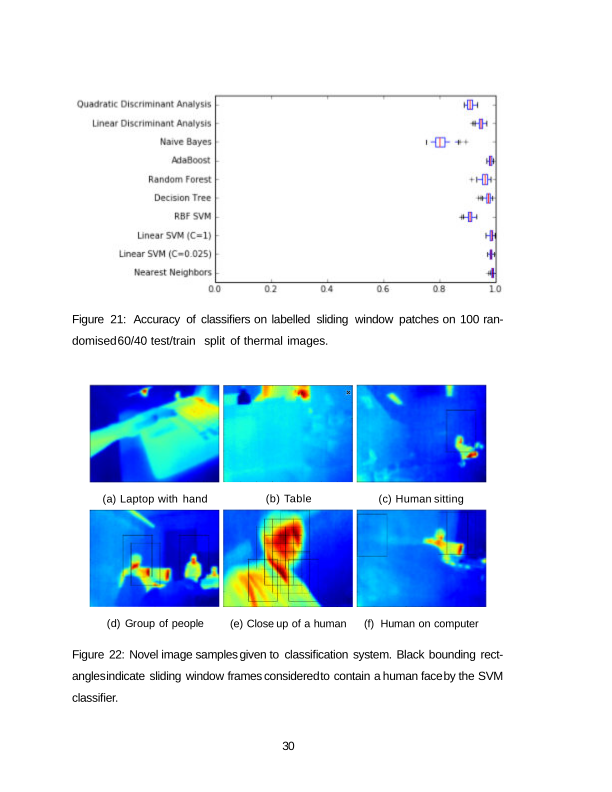
Vehicle Occupant Safety System (2016)
The purpose of this project was to design a system that could detect dangerous situations inside of vehicles to prevent harm to children, pets, the elderly or disabled. Such dangers included overheating and carbon monoxide inhalation. It was found that no product on the market currently addresses these concerns. The design allowed the system to notify users about possible dangers to the vehicle’s occupants via their phones through an onboard SIM card. The final design includes an IR camera that was effectively able to identify whether or not there were occupants in the vehicle, it also includes carbon monoxide, carbon dioxide, and temperature sensor. It is powered via a battery that is charged by the car’s battery. All parts of the system operated within acceptable conditions that the interior of a car would undergo. All available components were tested in these conditions. Recommendations included an easier and more versatile mounting system, use of embedded systems to reduce cost and profile, and better user feedback systems. Additionally, multiple IR cameras would allow a better field of view to more reliably detect occupants of the vehicle.
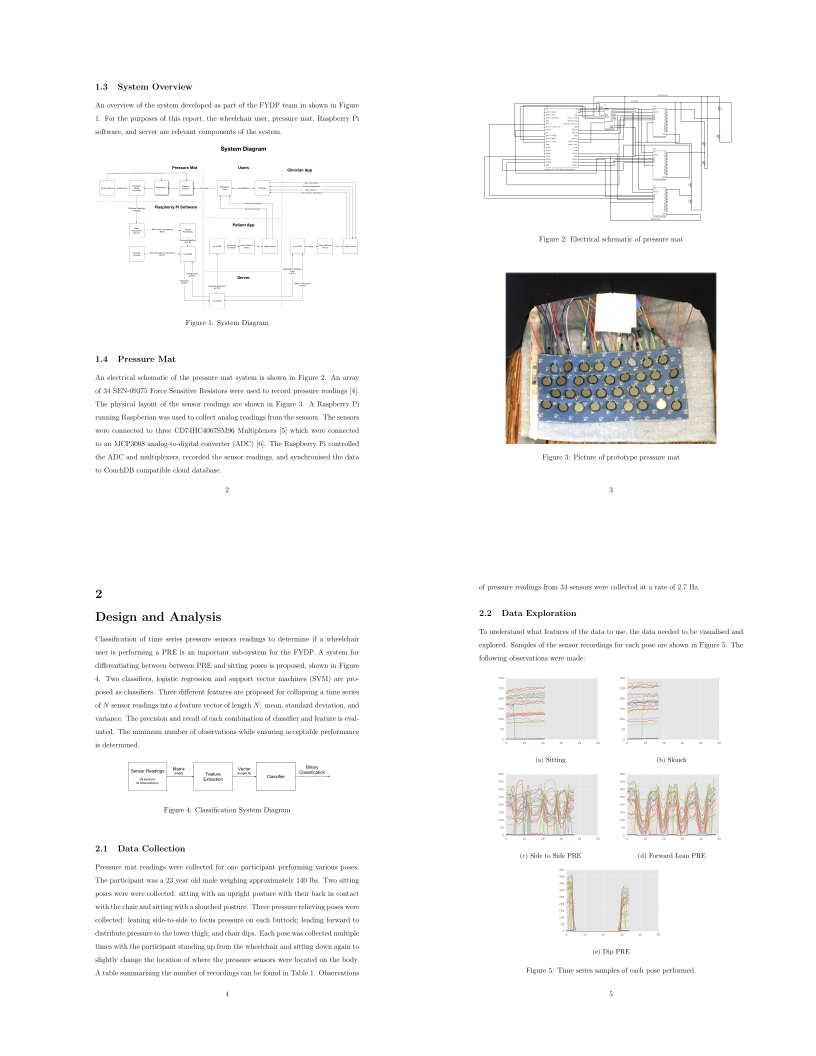
Design and Analysis of a System to Classify Occurrence of Pressure Relieving Exercises in Wheelchairs (2017)
Abstract—Studies have found that pressure injuries, also known as pressure ulcers or bedsores, affect up to 58% of all wheelchair users. The constant pressure against the patient’s body can result in injuries to the skin and underlying tissue. To reduce the occurrence of pressure injuries, wheelchair users are recommended to perform pressure relieving exercises (PRE). A system [was developed] developed by the author’s fourth year design project (FYDP) team which encourages wheelchair users to perform PREs regularly. An Internet of things (IoT) pressure sensing mat is used to collect sensor readings of various PRE and non-PRE exercises. A system is proposed to classify if a time series of pressure readings is a PRE. The system’s classification precision and recall is analysed and a suitable classifier and feature space is chosen. Recommendations for further improvement of the classification are discussed.
Projects
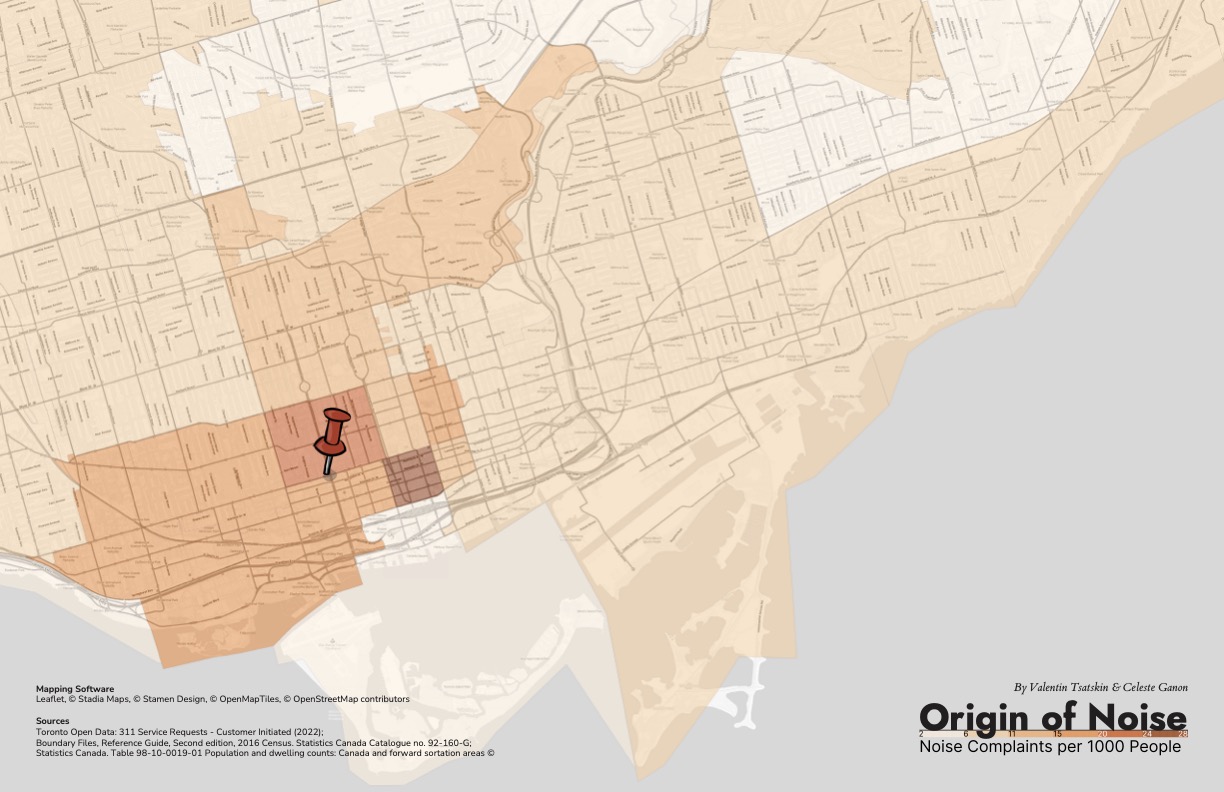
The Origin of Noise
A visualization of Toronto noise complaints occuring in 2022.
2023 Toronto Mayoral Candidates Explorer
A tool to help sort through the incredible quantity of candidates with substantive platforms during the Toronto Municipal Election of 2023.
Talks
†: Unfortunately indicating lost media :(
If you
somehow have a copy of any of these, I would greatly
appreciate if you could send me a copy.
Intervention Art Project (2019)
At PolyhackTO, I discuss a tech art project I built in 2017 while a student the University of Waterloo. The art’s themes are climate change and nature. I discuss the motivation, process, how it works, and encourage others to leave their comfort zones to create something new.
OpenCV Dance Party (2019)
At PolyhackTO, I discuss a tech art project I built at ChangeUp in 2018. Using computer vision, a digital audio workspace (DAW) can receive live crowd information via MIDI to generate music based on the topology and movement of the crowd. I discuss the motivation, process, and (as usual) encourage others to leave their comfort zones to create something new.
Improving Firefox Network Error Experiences (2014)
I discuss redesigning the experience of dealing with network related errors in Firefox. The goal: Less frustration, more browsing.
▶ Watch on Air Mozilla or check out the slides. †
Version controlled, open source design documents (2014)
A guided tour through my design methodology which introduces version control and open source thinking to User Experience design.
▶ Watch on Air Mozilla or check out the slides. †
Artwork
Crypto Poster
In light of all of the encryption talks as of late pertaining to the Apple vs FBI ordeal, I’ve created some posters for the badass that is Elliptic Cryptography. I also accidentally created a fractal and decided to name it the Snowden Snowflake.



UX Designs
Firefox: Network Error Design Specifications (2014)
A proposed redesign for Firefox’s Network Error pages. Most of the changes did not get implemeneted, however I’ve created a writeup outlining the design. Unfortunately there’s a bug in the build script for creating these docs which causes the correct fonts not to be included.
Firefox: Handling Captive Portals (2014)
This was an attempt at fixing the frustrating experience of using a public wifi and having to painstakenly log into it. You can check out the design docs on GitHub.
Firefox for Android: New Tab Experimentation (2014)
We invisioned that switching tabs should be easy enough you can do it one-handed. You can find the designs on GitHub.
You can also try an interactive web demo which conveys the interaction design details. We also built an Android app demo if you know how to sideload apps.
Firefox OS: Smart Data Consumption (2014)
A Firefox OS project to bring smart data consumption to users in emerging markets so that they can do more with less data. This project aimed to help keep users informed and in control of the data consumed by their mobile device and the applications on it.
Design artifacts:
Hackathons
I used to both participate in and organize hackathons. A Hackathon is “an event, typically lasting several days, in which a large number of people meet to engage in collaborative computer programming”— New Oxford American Dictionary Most of the time I had something worthwhile to show for the time spent. A curated list of such times is provided below.
Hack the North
I helped co-found Canada’s largest hackathon.
 I was involved in the first two itterations which occured in
2014 and 2015. It attracted 1000+ hackers from 100 schools in 10
countries.
I was involved in the first two itterations which occured in
2014 and 2015. It attracted 1000+ hackers from 100 schools in 10
countries.
My major involvement was leading the website team. I also happened to MC both times and I’m not really sure why anyone thought I would do a good job at that.
NavajoChat
I created a proof of concept Google Chrome extension to encrypt transmission of Facebook messages. The messages are not stored in plain text on the server and thus can only be read by the intended audiences. You can watch a demo video on YouTube.
For the curious, it uses OpenGPG for encryption. This isn’t a serious attempt at securing your messages and there’s probably plenty of holes. The code is open sourced on GitHub.
Lunch Roulette
We created an android app to pair you up with strangers to have lunches with. A silly promotional video is on YouTube.
I worked on the interface design. You can check out the design process in our slide deck (PDF). This occured at the inaugral Hacktech in 2014.
SurroundSound
My teammates and I tried to create a solution for delivering music most people at a social event would like. We attempt to provide a curated YouTube playlist for a DJ based on attendee’s music preferences. I think it worked once. The code is open-sourced on GitHub. This occured at the inaugral MHacks in 2012.